
The rise of Ozempic-style drugs has coincided with a steep drop in weight-loss surgery. Something similar may be starting in burn and wound care, where MediWound (NASDAQ: MDWD) sells a drug that dissolves dead tissue instead of cutting it out.
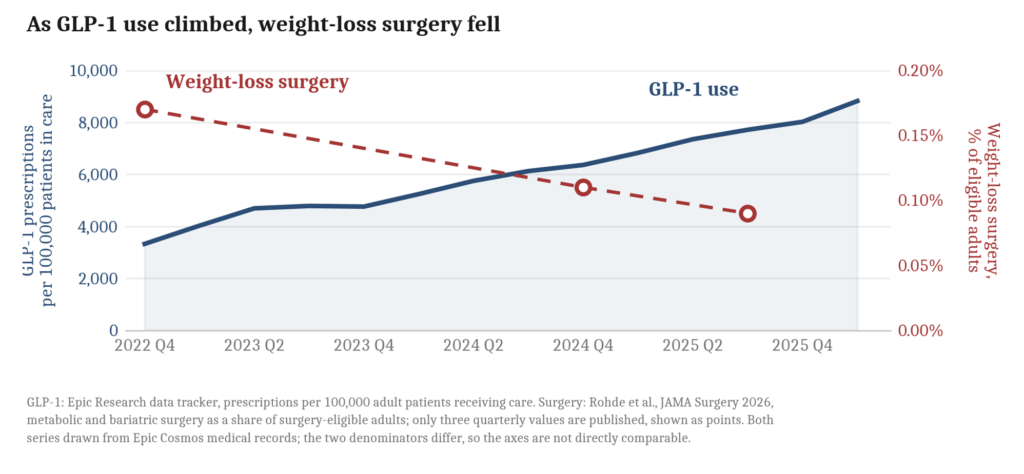
Most people know someone on Ozempic or Wegovy. Fewer noticed what happened to weight-loss surgery. Ohio State and Wake Forest researchers reported in JAMA Surgery that use of the operation among eligible patients fell 46.4% over the three years to Q3 2025, with sleeve gastrectomy, the stomach-shrinking version, down 50.1%. The study tracked the two trends together rather than proving one caused the other.
Hospitals spent decades making surgery cheaper, but a cheaper operation is still an operation. What changes the economics is when it stops being necessary. And the money did not come from what surgery gave up. Weight-loss surgery reached only 0.17% of eligible patients at its peak, while GLP-1 prescribing in that group hit 24%.The drug built a market far larger than the one it dented. Eli Lilly went from about $350 billion to over $1.1 trillion, briefly the first trillion-dollar healthcare company. The question is which field is next.
Wound care could be next. In deep burns, removing the dead layer has long meant surgical excision, usually in an operating room under anesthesia. Because burn depth is hard to judge beneath opaque dead tissue, cutting can take healthy skin with it. In a wildfire, a factory explosion or a war, burn units run out of surgeons and operating rooms long before patients.
MediWound does that job biologically. Its FDA-approved drug, NexoBrid, is an enzyme product. Spread under a dressing for about four hours, it dissolves the thick leathery crust a deep burn leaves behind, known as eschar, while largely sparing healthy tissue. It is sold in the U.S., Europe, Japan and other markets. Vericel (NASDAQ: VCEL), a burn and sports-medicine specialist holding the exclusive North American license, reports growing U.S. adoption, and MediWound has reaffirmed 2026 revenue guidance of $24 to $26 million.
MediWound’s own pivotal trial, one of two behind U.S. approval, put 175 patients on the gel, surgery or a placebo. The gel cleared dead tissue in a median of one day against 3.8 days for surgery. General anesthesia was needed for 5% of gel applications and 87.5% of the surgical ones, though that was not a formal endpoint. A separate program published this year in the Journal of Burn Care & Research covered 239 patients at 23 U.S. burn centers, showing that Nexobrid cleared eschar in 95% of adults and every child within four hours. Only 4.2% of adults and none of the children required any surgical excision. Everyone got the drug, so there was no comparison group, and clearing dead tissue is only the first step, since many patients still needed skin grafts.
Governments are buying. BARDA, the U.S. health agency that funds and buys medical countermeasures for emergencies, awarded Vericel a ten-year contract worth up to $197 million, largely to stock NexoBrid in the national emergency stockpile. MediWound manufactures what Vericel sells, so those orders flow back to it. Of that, $35 million is committed up front, including about $10 million of product in the first year. The rest rides on options for more stockpiling, a possible blast-injury use and a U.S. factory. Expert panels in Japan and the UK have published national consensus documents, adding to earlier European guidelines.
The bigger prize is chronic wounds: leg ulcers, diabetic foot sores and bedsores that will not heal. Roughly 10.5 million Medicare patients had a wound in 2019, at a cost of $22.5 billion. Company-commissioned research puts the U.S. market for enzymatic wound cleaning above $2.5 billion. Santyl, an enzyme ointment approved in 1965, is estimated to earn over $400 million a year. U.S. wound specialists argued in April for trying less invasive options first.
MediWound’s candidate for that market is EscharEx, still experimental, now in a late-stage trial targeting 216 patients across 40 sites enrolling, with completion targeted for the end of March 2027. Studies in diabetic foot sores and bedsores are lined up behind it, and MediWound says every major wound care company relevant to the program has joined as a research collaborator.
The pull is real. Patients want less cutting, hospitals want fewer operating room hours, preparedness planners want options that stretch scarce burn expertise, and patients outside the hospital setting need less invasive options. Weight-loss drugs showed how fast a field turns once a credible alternative arrives. In burns, MediWound already has one on the market and a government contract behind it. Whether the same holds in chronic wounds is what the trial now underway is built to answer.
Recent News from MediWound (NASDAQ: MDWD)
MediWound Reports First Quarter 2026 Financial Results and Provides Corporate Update
Newly Published U.S. Expert Consensus Aligns with MediWound’s Strategy for Chronic Wound Debridement
MediWound to Present New EscharEx Data at Leading Wound Care Conferences
MediWound Reports BARDA Contract Award to Vericel for NexoBrid Valued at up to $197 Million
Subscribe for Similar Reports
Read More from The Finance Herald
- Gap’s 13% Rally Puts Old Navy at the Center of Its Turnaround Test
- Apollo’s Atlantic Aviation Deal Reprices Private-Jet Infrastructure
- Nvidia’s 70% Growth Forecast Turns the AI Boom Into a Supply-Chain Test
- Canada’s Counter-Tariffs Raise the Price of Defending an Integrated Economy
- RBA’s August Pause Leaves Australia’s Next Rate Move Unsettled
- SoftBank’s Record Retail Bond Turns Its AI Ambition Into a Funding-Cost Test
- Trump’s 1,051 June Trades Expose the Limits of Financial Disclosure
- U.S. Services Surge Turns Stronger Growth Into a New Rates Test
- NetEase’s Revenue Beat Puts the Focus on the Quality of Its Gaming Growth
- Santander’s Webster Deal Turns U.S. Scale Into an Integration Test
Important Disclaimers and Disclosures: The author, Wall Street Wire, is a content and media technology platform that connects the market with under-the-radar companies. The platform operates a network of industry-focused media channels spanning finance, biopharma, cyber, AI, and additional sectors, delivering insights on both broader market developments and emerging or overlooked companies. Wall Street Wire is not a broker-dealer or investment adviser. References to market size estimates, valuations, price targets, or other third-party data are provided strictly for informational purposes. Wall Street Wire receives cash compensation from MediWound Ltd. (the “Issuer”) for coverage and awareness services, which are provided on an ongoing subscription basis. The content above is a form of paid advertising and promotion and is for informational purposes only and does not constitute financial or investment advice. This article may contain forward-looking statements about the Issuer’s products, plans, or prospects that are subject to risks and uncertainties; actual results may differ materially, and readers should review the Issuer’s public filings on SEC EDGAR (sec.gov/edgar) for full risk factors. Market size figures, research estimates, or other third-party data referenced in this article are quoted from publicly available sources believed to be reliable; however, we do not independently verify or endorse them, and additional figures or estimates may exist. Full compensation details, information about the operator of Wall Street Wire, and the complete set of disclaimers and disclosures applicable to this content are available at: wallstwire.ai/disclosures. This article should not be considered an official communication of the Issuer. Images may be computer generated and are for entertainment and visualization purposes only, and may not be an accurate or exact depiction of the technology.