
War Unicorn Hermeus Raises $350 Million For Unmanned Supersonic Fighter Jets
Atlanta-based aerospace startup Hermeus Corp. has successfully completed a $350 million funding round, pushing the company’s valuation beyond the $1 billion mark. The achievement establishes Hermeus as the latest “war unicorn” in the defense technology sector, according to recent reports.
The Series C financing was spearheaded by Khosla Ventures and drew participation from prominent investors including Founders Fund, Canaan Partners, RTX Ventures, and In-Q-Tel. With this latest injection of capital, Hermeus has accumulated over $500 million in total funding since its inception.
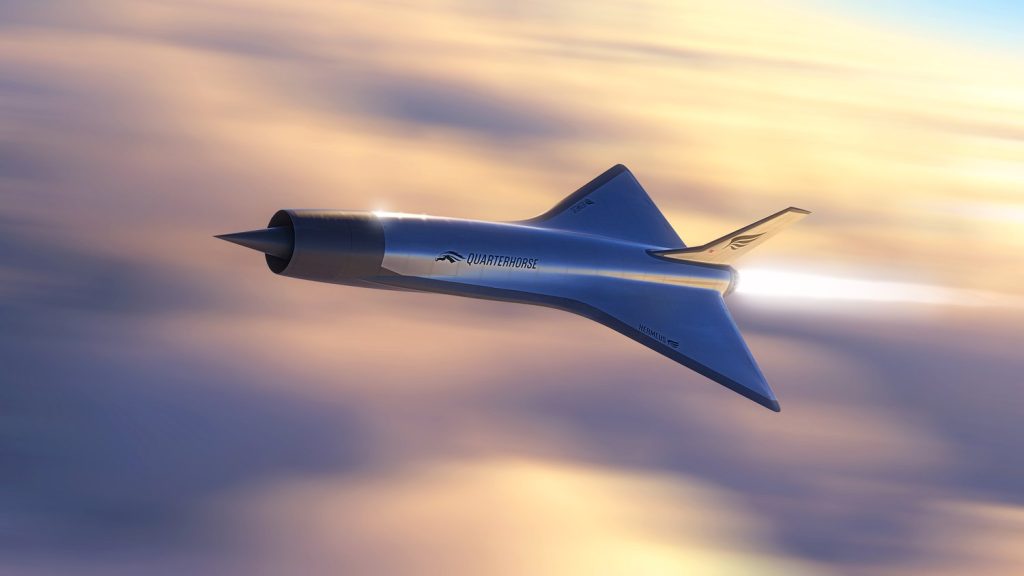
The aerospace company plans to deploy the newly acquired capital toward constructing two additional supersonic aircraft from its “Quarterhorse” lineup. Additionally, the funds will support expanding manufacturing operations as the company advances development of unmanned aerial vehicles capable of achieving speeds of Mach 3 and beyond.
Hermeus unveiled its Quarterhorse Mk 2.1 design, describing it as an F-16-sized aircraft engineered to exceed the speed of sound. The aircraft represents the first in a series of three jets within the Mk 2 family. The company has adopted an accelerated development approach, building and testing multiple aircraft in quick succession rather than waiting years between test flights. This methodology allows real-world flight data from one aircraft to inform the design and development of subsequent models.
Beyond the Quarterhorse program, Hermeus is advancing work on “Darkhorse,” a hypersonic unmanned aircraft designed to operate at even greater speeds. The company positions hypersonic aircraft as transformational assets for defense capabilities, offering enhanced responsiveness and survivability for the United States and allied nations.
The defense startup’s aircraft are engineered to deliver payload capacity comparable to traditional fighter jets while operating as unmanned platforms, potentially offering cost advantages over conventional manned aircraft systems.
Hermeus was established in 2018 and represents part of a growing wave of defense technology startups that have emerged as alternatives to traditional defense contractors. This new generation of companies has been characterized as “war unicorns” by industry observers, reflecting their billion-dollar valuations and focus on innovative military technologies.
The shift toward funding these emerging defense companies reflects a broader transformation in military procurement processes. The Department of Defense has increasingly directed resources toward startups rather than relying exclusively on established defense contractors, which have faced criticism for inefficient use of taxpayer funds.
Vinod Khosla, founder of lead investor Khosla Ventures, emphasized the strategic importance of Hermeus’s mission. He noted that the United States currently trails both Russia and China in hypersonic flight technology and weapons development, making initiatives like Hermeus strategically crucial for national security.
The United States continues to conduct testing of hypersonic weapons systems while both Russia and China have already deployed operational hypersonic weapons. This technological gap has created urgency around developing domestic hypersonic capabilities, positioning companies like Hermeus as critical players in closing this strategic deficit.
Hermeus’s approach focuses on rapidly iterating aircraft designs through successive builds and test flights, accelerating the development timeline compared to traditional aerospace programs. This methodology aligns with broader trends in the defense sector toward more agile development processes and faster deployment of new technologies.
The company’s dual-track development of both the Quarterhorse supersonic platform and the Darkhorse hypersonic system demonstrates an ambitious roadmap for advancing high-speed unmanned aerial capabilities. These platforms could potentially serve various military applications, from reconnaissance to rapid response missions.
The substantial valuation achieved through this funding round underscores investor confidence in both Hermeus’s technology and the broader market demand for advanced unmanned aerial systems. As geopolitical competition intensifies and adversaries deploy
increasingly sophisticated weapons systems, the market for
next-generation defense technologies continues expanding, creating opportunities for innovative startups to challenge traditional industry dynamics.